
The Platform — AppNet
The first framework for delivering applications as a service over a network.
AppNet was the application delivery layer built on top of the SuccessInc gateway. Where the gateway handled the network connection, the user accounts, and the shared data store, AppNet was the framework that let applications be built on top of that infrastructure and delivered to users over the connection.
This is what would later be called Software-as-a-Service. In 1988, it had no name.
What AppNet Did
AppNet provided a structured environment for building industry-vertical applications — applications specific to a particular business or sector — and delivering them to users who authenticated over the network.
A user would connect, authenticate once, and have access to the applications relevant to their context: employment, insurance, community, data. The application ran centrally. The user needed only a connection and credentials.
This was the central insight of the ASP model: the application does not live on the user’s machine. It lives on the server. The user accesses it over the network. Every update, every data change, every new feature — centrally managed, instantly available to every connected user. This is now called SaaS. In 1988, SuccessInc was running it.
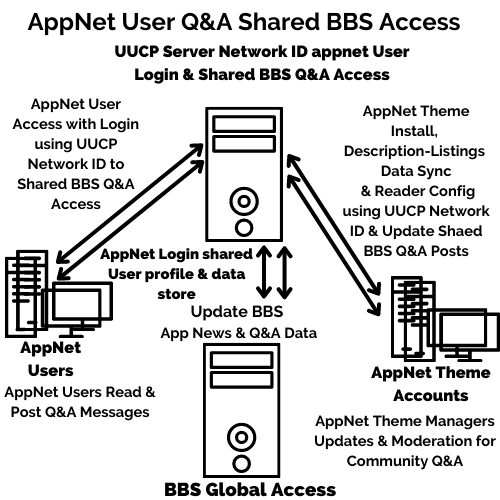
The complete AppNet architecture — repository, applications, themes, users, login, accounts, data store, BBS, community
The ASP Model Before the ASP Model
The term “Application Service Provider” did not emerge in mainstream industry conversation until the late 1990s. Analysts spent the early 2000s debating whether the ASP model was viable.
SuccessInc had been running it since 1988.

SuccessInc’s place in ASP history — and the path from 1988 to Milinx’s recognition as an industry leader