

Before the Cloud Had a Name
In 1988, a three-person team paid for by Maynard L. Dokken (often written Maynard Dokken) was running applications as a service over phone lines, a decade before the industry coined the term “application service provider” in mid-1998. No investors. No web. No name for what they were building. It worked anyway.
A historical record of what was built, and how
“They said it could not be done. Then they looked at the site and changed.”
The diagrams on this site were redrawn later, from what survived of the work and from memory
The Platform
Four components, built from 1987 to 1994, before the industry had a name for the model
Applications
The AppNet framework — industry-vertical applications delivered over the network
1987–1988The Gateway
Built on Minix — two modems, one shared database, one login
1988First App
Online employment recruitment — SuccessInc’s first application
1994Community
An early in-application Q&A and knowledge base
The Application Gateway
One IBM PS/2 with Micro Channel, two modems, one shared database and one login for several accounts, on an operating system whose serial support had to be written first.
The diagram to the right was redrawn later, from what survived of the work and from memory. In 1988 everything was text, and images could not be sent.
How It Was Built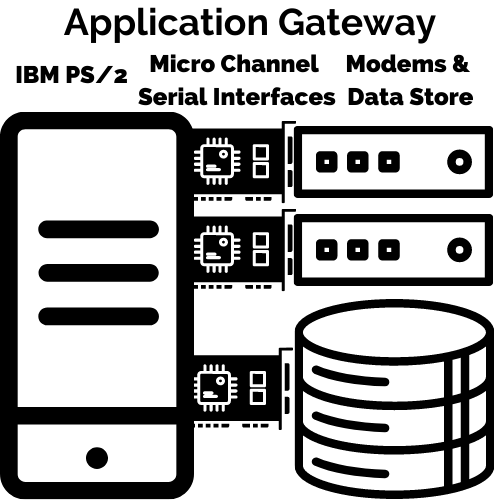
The Application Gateway — redrawn later from what survived of the work and from memory; in 1988 everything was text
Fourteen Years
SuccessInc to Milinx: application gateways, online payment, IVR, cloud infrastructure, mobile apps, meta-databases, biometric encryption, patents
The idea: link the universities to employment databases
The gateway: PS/2, two modems, Minix
AppNet and the first application
UUNET becomes a paid service
Refocus on corporate intranets
Security risks found; a ratings agency alerted
Community layer; Assured Card founded
Assured Credit, then Milinx